· Art History · 4 min read
Plein Air Painting, Seen on a Map
Follow paintings back to the places that shaped them—from Monet and Van Gogh to Turner, Yoshida, and artists working outdoors today.
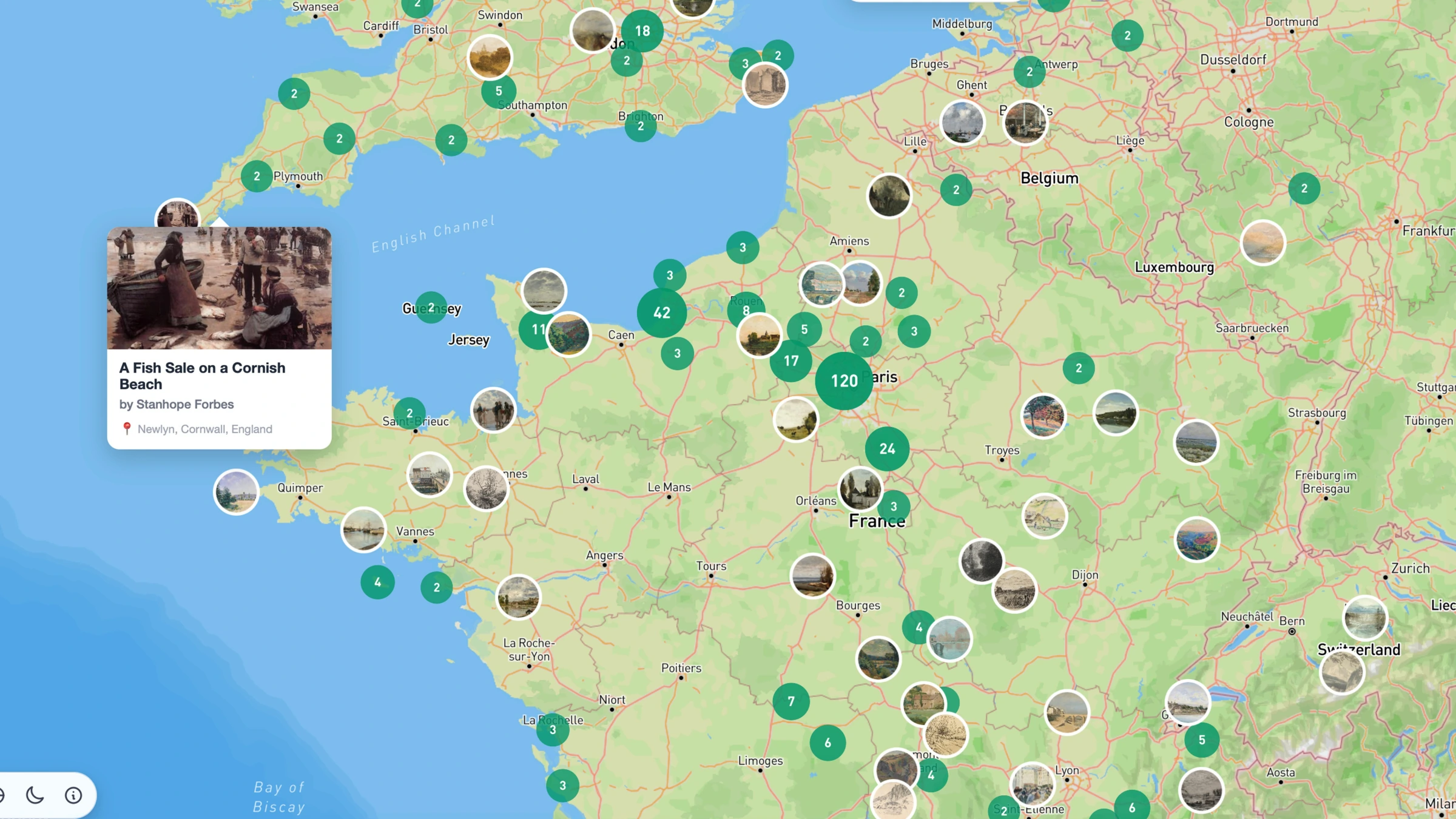
Most art history begins with a name, a date, and a museum wall. For anyone who works outdoors, there is another question worth asking: where was the artist standing?
On Sketch Nomad, historical paintings sit on the same map as work made by artists today. A pin gives a painting its setting again: a stretch of coast, a riverbank, a street, a field, a view that another artist once chose to stop for.
It is not a replacement for seeing the work in person. It is a different way into it—through the ground, weather, and distance that shaped the image.
Start with a place
If you are planning a day out with a sketchbook, a map can be more useful than a list of famous paintings. Zoom into an area that interests you, open a work, and look at the place around it. You may notice what brought the artist there: the turn of a river, a high horizon, an open square, or light arriving from the water.
That is the point of mapping these works. Not to turn painting into a checklist, but to make the connection between a work and its surroundings easier to feel.
Follow the painters, then wander
The map includes artists whose work is closely tied to working from observation outdoors.
Start with the French painters if you are drawn to rivers, gardens, and changing coastal weather: Claude Monet, Camille Pissarro, Eugène Boudin, Alfred Sisley, and the Barbizon painters including Corot and Daubigny.
For unsettled skies, water, and atmosphere, follow J. M. W. Turner and John Constable. For the intensity of a place seen quickly and directly, spend time with Vincent van Gogh. His work is a reminder that a familiar field or road can still be a demanding subject.
There are other routes through the map too: American landscape painters such as Frederic Edwin Church and Childe Hassam; the clear, sunlit scenes of Joaquín Sorolla; and Hiroshi Yoshida, whose travel prints make the act of looking from one place to another feel especially alive.
You do not need to know the movements or the chronology. Pick an artist, open a pin, and see where it leads.
What to notice when you open a pin
The useful part is not only the location. It is the chance to look more carefully.
- The viewpoint. Is the artist looking across the scene, down into it, or through something closer by?
- The conditions. What might the light, season, tide, or weather have asked of the artist that day?
- The return. Did other artists work nearby? Did the same person come back to the subject from another angle?
Those questions are useful whether you paint in oils, work in a small watercolour book, or draw for twenty minutes on a walk.
A living layer of outdoor work
Historical works are only one part of the map. They sit beside sketches shared by living artists, so a place can hold its long visual history and its present-day life at once.
That makes the map less like a museum catalogue and more like a field of references. You might open it looking for a place to draw, and leave with a better sense of how someone else noticed that place before you.
Explore the map
Open sketchnomad.app, choose Curated Artists, or simply move around the map until a place catches your attention. Open a pin to see the work, its location, and its source.
For more context on the tradition, read our history of plein air painting or explore Van Gogh & En Plein Air.
Frequently asked questions
Is the historical layer free to explore?
Yes. The map and curated historical works are free to browse on sketchnomad.app.
Can I browse a particular artist?
Yes. Open Curated Artists in the app, or begin with Monet, Van Gogh, or Turner.
How is this different from a museum collection?
Museum collections are organised around artworks and artists. Sketch Nomad starts with place, so you can see work in relation to the landscape, street, or coastline where it was made.
Will the map include more artists over time?
Yes. The historical layer will continue to grow as works are researched and connected to their locations.


